
Types of Construction Equipments :
- Excavating Equipments
- Hoisting Equipments
- Compaction Equipments
- Conveying Equipments
- Hauling Equipments
- Pumping Equipments
- Drilling Equipments
- Road Making Equipments
Types of Construction Equipments:
Intermittent Type
These types of equipments have intermittent cycles of work. They are operated on series of work cycles and each cycle completes in itself.
Power shovels, draglines and bull dozers are examples of Intermittent type equipments.
Continuous Flow Type
These types of equipments have a continuous flow of work turned out. Belt conveyors and Pipelines are examples of Continuous Type of Equipments.
Mixed Type
These types of equipments have characteristics of both continuous and intermittent type equipments. They are continuously operated over a defined surface area.
After completion of a particular sweep, it requires adjustment of its position to resume production. Motor graders and scrapers are examples.
Advantages of choosing Standard Equipments :
- Initial investment is less
- The delivery period is short as it is readily available in market.
- It is reliable in operation due to wide experience and design.
- Repairing is easy and short.
- The resale value is high.
- Multi purpose operations at a site.
Excavating Equipments
This section deals with various types of Excavation equipments along with their engineering properties.
Excavation Equipments :
[1] Tractor
Exert tractive force for pulling other Equipments and machines.
Use : bulldozer, angle dozer, hoeing, tilling and harvesting
Crawler mounted or wheel mounted.
[2] Bull Dozer or Angle Dozers
To clear site, level land, prepare pilot road and small excavation (100 m)
Crawler mounted : low speed, soft ground only, more cost, no slip
Wheel mounted : higher speed, paved road
Angle dozer : blade fixed at angle with direction of travel.
Capacity is determined by blade dimention.

[3] Grader
To level ground and spread loose material.
Self propelled and towed by tractor
3-4 m long angled blade
Side cutting, road crowning and bank dressing
[4] Scraper
Consist of large bucket, called scraper.
Capacity : 3-9 m3
It has cutting edge or blade at bottom.
Possible to dig earth to a depth of 250 mm.
During forward movement, blade cuts ground and loosened earth is collected in body.
It combines digging, conveying and dumping.
Mounted on 2-4 pneumatic tyred wheel.

[5] Excavator
Remove earth and move it while remain stationary.
Types of Excavator Equipment :
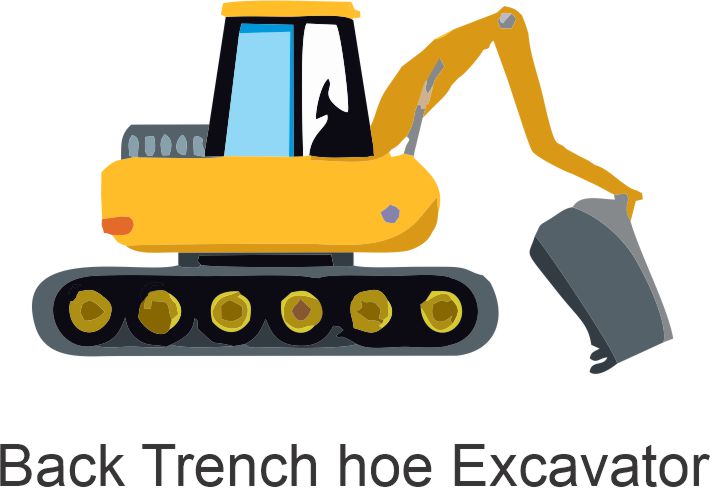
(a) Back Trench Hoe excavator
- for digging foundation trench below operation level.
- for basement, footing and trenches.
- contain hoe that scrape or dig the earth
- can be used as loading carrier.
- ground : hard firm ground (more rigid)
- digging result from drag of bucket.
- most efficient in loading carrier.
(b) Clamshell excavator : vertical range
- For digging below, at or above operating level in a vertical range.
- Ground : relatively loose or soft medium hard
- working in limited space
- consist of bucket of two halves that are hinged at top.

(c) Power shovel excavator : soft rock
- carry shovel at lower end, with sharp cutting edge
- dig material at or above operating level. (more output than hoes)
- wide area for working space.
- Ground : loose rock
- Parts : boom, cabin, dipper, hoist line, mounting, power system.
- Force is applied through dipper stick at the same time tension is applied in hoisting line to pull dipper up the face of pit.
- Angle of swing should be 90˚
- more output than dragline.
- Fill factor range for well blasted rock = 0.9-1
- Optimum depth of cut does not vary with size of dipper.
\color{magenta}{Output = \frac {Volume\: of\: excavated\: material}{T\times N}}T : Time taken to complete one cycle of excavation (hrs)
N : no. of such cycles in one hour.
Output is independent of size of truck.
(d) Dragline excavator :
- digging at or below operating level.
- For river dredging and canal dredging.
- More superior for excavation.
- Use : wet bottom, well below ground level and canal
- Output : (75-80)% of shovel of same capacity.
- Can work on natural ground.
(e) Skimmer :
- Carry skimmer at lower ends.
- Used for surface excavation and levelling.
- Cut surface of earth to depth of 200 to 300 mm.
(f) Dredger :
Provide necessary depth of water near port.
Type :
- Bucket ladder : endless chain of bucket mounted on ladder.
- Dipper : pontoon carrying frame with revolving boom.
- Grab : grab suspended from cable.
- Hydraulic : sand pump with cutter.

(g) Ripper/ Rooter/ Scarifier
- Carry 2-4 teeth, used to break up the ground.
- For stiff clay and soft rock.
- drawn by tractor.
- Depth : (300-750) mm
(h) Trencher / ditcher
To excavate trenches of width (200 – 450) mm and depth 4 m with accuracy and speed.

Earth Compaction and Hoisting Equipments
This section deals with various types of Compaction and Hoisting equipments along with their engineering properties.
Earth Compaction Equipments
Types of Roller Equipments :
[1] Rubber Tyred or Pneumatic Roller :
Earth Subgrade, Granular soil.
Used in bituminous surface dressing.
[2] Sheep Foot roller :
Clayey soil (mixture of clay + sand), cohesive soil
Steel cylinder (1.2 m long and 1.2 m diameter) with projection of steel.
Projection penetrate layer and compact it by kneading.
[3] Smooth Wheeled roller :
Multipurpose, All types of road
Preferably granular soil and pavement layer
crushing action.
[4] Vibrating Roller :
Vibrating unit mounted on plate or roller.
For coarse grained soil (non-cohesive)
[5] Earth Rammer :
May be static or vibrating close to surface only.
[6] Grid and Mesh Roller :
Compaction of gravel base.

Hauling Equipments
- Truck
- Tractor
- Dump Truck : (50-55 tonne), Articulate or rigid type
- Dumper : horizontal transportation of material for short distance.
- Trailer
- Conveyors : Flat running surface for carriage
Hoisting Equipments
Cranes
Raise and shift heavy load from one place to another.
Three Operation
- Hoisting : raise and lower load
- Luffing : move boom in or out
- Slewing : move boom in arc
Crawler mounted : limited load – 75% of tipping load
Rubber Tyre mounted : limited load – 85% of tipping load
Types of Crane Equipments :
[1] Derrick cranes
- Open site very long reach
- Slewed for 250˚ approx.
- Swing jib crane: slew 360˚, more mobile
[2] Goliath cranes
- Heavy temporary staging or platform
- Construction of harbour works, shops of steel work
[3] Tower crane
- Swing jib type
- Mounted on high steel tower (25-30) m
- Construction of tall buildings in congested areas.
- Type : mast, movable crane, telescopic stationary, non-telescopic rotating, telescopic travelling
- Mast tower crane with counter weight has cantilever jib.

[4] Cableways
- Coil : diameter= 50-100 m
- Transport of concrete from one place to other in restricted area.
- Coil is suspended between two towers and support a carriage.
[5] Hammerhead
Has cantilever arms on both sides.
[6] Floating Crane
Hydraulic structure (boom length and angle can be changed)
[7] Mobile Crane
Railway electrification.
[8] Electric overhead crane
It has 3 way crane motion
[9] Travelling bridge
It has legs moving on tracks laid on floor.
[10] Gantries
- To replace ordinary scaffolding
- Mobile framed structure of steel or timber
- Type : Derrick tower gantry, Platform gantry and Travelling gantry.
Load capacity of crane : depends on stability of footing, strength of boom and counter weight.
Working range : limited by length of jib
Concreting Equipments
Mixer
Tilting : large work, large size aggregate, used when capacity > 200 L
Non Tilting : small scattered job, small aggregate (<7.5 cm)
Reversing : more capacity than tilting
Aggregates are collected in dry condition in hopper. It is necessary to pour water in mixture at the same time or before the other materials are placed.
Mixing time should be at least (1-2) min.
Quantity should not be more than the quantity that can be used in less than 30 min after completion of mixing.
Large mixer : additional mixing allowed.
Mass batch mixing is most desirable since bulking of aggregate does not influence it.
Capacity of mixer : specified by nominal volume of concrete that can be mixed in a batch.
400NT Mixer : Non tilting mixer with capacity of 400 L
Pan mixer : handle stiff and cohesive mix for pre cast element. (axis vertical rotation).

Conveying Equipments
These equipments transport materials packed in bags, cartons, boxes or barrels for a short distance.
Types of Conveyors :
Belt Conveyors
They convey, handle and transport materials such as sand, cement, aggregates, concrete and earth. They are continuous flow type equipments and work at high speed and efficiency.
A belt conveyors consists of continuous belts, Idlers (to support belt), Driving unit, Pulley, Take up equipment (check elongation in belt) and supporting structures.
Concrete Belt Conveyors
They transport concrete in large quantity with proper handling at large construction sites. It has a specific design to discharge concrete uniformly over placement area.
They nylon belt ensures that concrete is conveyed in central portion of belt in order to avoid excessive spilling and loss of large aggregates of concrete.
They can be portable, Feeder type or Spreading type conveyors.
Ropeways
They discharge loads automatically at any point from any desired height. They provide haulage service in rocky hilly terrain and their working is not disturbed by extreme weather conditions.
The initial cost of installation of ropeways is high, hence they are preferred for large quantity operations.
Manilla ropes are generally used for hoisting purpose since they have huge tensile strength and they do not coil on a damp surface.
Road Mixing Equipments
- Bitumen boiler
- Dozer : grading
- Grader : spread loose material, give shape to subgrade
- Roller : rolling and compacting subgrade
- Scarifier : loosening old road to predetermined depth
- Scraper : carry out earthwork, excavate and collect material.
[Numerical Concepts]
Traction : frictional resistance developed by machinery.
\color{blue}\large{T = \mu w}Utilization Factor = Engine Factor × Time Factor
Effective cycle time:
Capacity : C m3
Efficiency : n %
Haul distance : d
Trip Time : t sec
\color{blue}\large{Forward\: Loading\: Speed = a = \frac {n}{100}a}\color{blue}\large{Return\: Unloading\: Speed = b = \frac {n}{100}b}Effective Cycle Time = Forward Traveling time + Return Time + Fixed Time per trip
\color{blue}{Effective\:Cycle\:Time =\frac {d}{\frac {n}{100}a}+ \frac {d}{\frac {n}{100}b}+ t}For Roller or Dozer :
\color{magenta}{Output = \frac {Average\: speed \times Effective \:width}{n}}Area cleared by dozer = Average Speed × effective width
Probability Problem :
Probability of load exceeding desired load = P1
The Probability of strength of equipment will be more than desired load = P2
Probability of failure = P1(1-P2)
Probability of getting late per person = P1
The Probability of arriving on time= P2 = (1-P1)
For three groups
P (Job getting delayed by due to non arrival of any one group)
\large\color{magenta}{P = P_{1}P_{2}P_{2}+P_{2}P_{1}P_{1} +P_{2}P_{2}P_{1} }Number of trips of dumper per Hour :
\color{magenta}{N = \frac {60 \:min}{Effective\: cycle\: time\: in\: min}}Output of earth moving equipment Q (m3/hr)
q : production per cycle in m3
C : cycle time (sec)
η : efficiency
\large\color{magenta}{Q = \frac {q \times 3600\times \eta}{C}}