
Composition of Cement
This section provides us information about manufacturing of cement and all its ingredients that form bulk of cement and provide chemical properties.

Manufacturing of Cement :
Dry Process :
Aerated power to granulated disk, small quantity of water (12%) to form Cement.
Wet Process :
- Water and Crushed lime is added to clay. Now water is added to make it wet and then slurry so formed is mixed in grinding mill thoroughly.
- Then blending of slurry to correct composition.
- Storage of mix
- Conversion of Slurry to clinker in rotary kiln.
- Grounding of Clinker in ball mill along with addition of 2-3 % Gypsum
- Packing in bags
Chemical Composition :
- CaO : (60 – 67) %
- SiO2 : (17 – 25) %
- Al2O3 : (3 – 8) %
- Fe2O3 : (0.5 – 6) %
- Alkalis (K2O , Na2O)
- SO3
Bogue’s Compound :
They are formed after fusion and chemical reaction between raw elements. They are intermediate chemicals that afterwards reacts with water to form core products.
- C3S : 3 CaO.SiO2
- Product C2S : 2 CaO.SiO2
- C3A : 3 CaO.Al2O3
- Product C2AF : 4 CaO.Al2O3.Fe2O3
Properties of Bogue’s compounds :
- C3S (54 %) : Early Strength, More heat of hydration, Fast, Produce less CSH and more Ca(OH)2
- C2S (16 %) : Later Strength, Slow, less heat produce CSH gel (dense paste)
- Product C3A (10 %) : Form CAH gel (cubic), Fast, faster reaction with water than C3S
- Product C2AF (9.1 %) : Form CaO.Fe2O3.H2O, C3FH6 , High resistance to chemical
Hydration :
Exothermic Reaction between cement and water. The heat generating from reaction, is called the heat of hydration.
Products of hydration :
C-S-H :
- Calcium Silicon Hydrates
- C3S, C2S + H2O = C-S-H + Ca(OH)2
- Most Important product
- (50-60) % of volume
- Crystalline and fibrous mass
- Ca(OH)2 (20-25) %
- C3S : produce less C-S-H, More Ca(OH)2 which gets out by leaching
- C2S : produce more C-S-H gel, More dense and specific surface
Ca(OH)2 :
- (20 – 25) %
- React with sulphate to form CaSO4 which react with C3A
C-A-H
- Calcium Aluminium hydrates
- By reaction of C3A with water
- Fast reaction, Flash set
- Gypsum is added to avoid flash set
- Do not contribute anything to strength
- Attack by sulphate
CaO.Fe2O3.H2O :
- Hydrate Calcium Ferrite
- Stable form C3FH6
- Do not contribute to strength
- Higher resistance to Sulphur attack
Ettringite :
- Calcium Aluminium Trisulphate Hydrate C6AS3H32
- Crystallize as short prismatic needle.
- Conversion to monosulphate later on.
Water requirement for hydration :
C3S : 24 % H2O
C2S : 21 % H2O
Total 38 % (23+ 15)
23 % of water by weight of cement is required for chemical action. They are called chemically bound water
15 % of water is required to fill up the gel pores
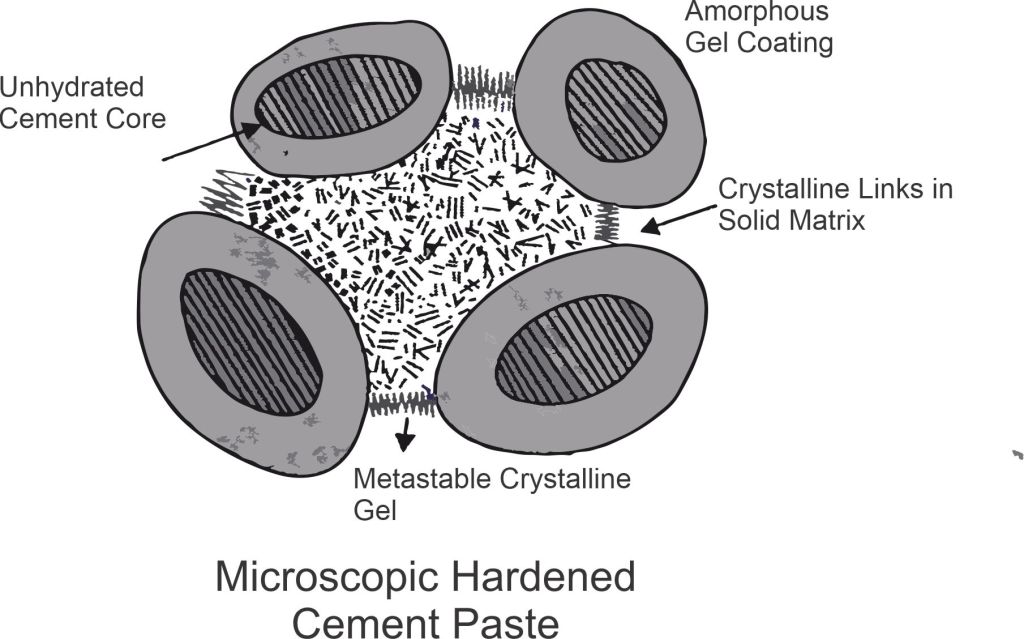
Structure of Hydrated cement :
We generally consider Concrete as two phase material – Paste phase and Aggregates phase.
At microscopic level, The region in vicinity of aggregates particles turns up to be a third phase which is known as transition zone.
Transition Zone : aggregate particle are dispersed in matrix of cement paste.
This transition zone is generally a plane of weakness as quality of paste in transition zone is of poorer quality. Firstly, due to internal bleeding, water accumulates below elongated, flaky and large particles of aggregates. This reduces the bond between paste and aggregates.
Also due to drying shrinkage, the transition zone develops micro cracks.
Testing of Cement
In this section we will see various types of tests we use to determine fineness, strength, consistency and soundness of Cement.
Testing of Cement
Field Testing
- Open the bag and look into it. There should not be any lumps.
- The colour should be greenish grey.
- It should feel cool when we thrust our hands into the bag.
- Take a pinch sample and feel it between the fingers. It should give a smooth and not a gritty feeling.
- The handful of sample when thrown into bucket of water should float for some time.
- Take 100 g of powder and add small quantity of water to form paste. Then pat a cake with sharp edges. Put it on a glass plate and place it under water. Now the shape of cake should not get disturbed and after 24 hours the cake should retain its shape.
Fineness Test:
- Fineness contributes to hydration rate and rate of gain in strength.
- Maximum number of particles in sample should have a size less than 100μ
- Tested in two ways :
- Sieving
- Determination of specific surface by air permeability test. (cm2/g)
Sieving :
100 g of cement is sieved on standard IS sieve no. 9 (90 μ) for 15 min. The weight of residue should not be greater than 10%
Air Permeability Method :
Measure specific surface.
Air is passed through cement bed at constant velocity. Adjust rate of air flow until flowmeter shows a difference in level 30 – 50 cm.
Apparatus : Blain air permeability apparatus
\color{blue}\large{S_{W}= k\sqrt{\frac{h_{1}}{h_{2}}}}h1= Difference in level of flowmeter.
h2 = Difference in level of manometer.
SW= Specific surface
Standard Consistency Test :
- Aim : Setting Time (Initial and Final), Soundness of cement, Strength
- Vicat Plunger : d = 10 mm ; l = 50 mm ; Vicat apparatus
- Depth = (33-35) mm (standard)
- Percentage of water required to get standard consistency paste.
- Temperature : 27 °± 2° C
- Humidity : 90 %
Setting time test :
Initial Setting time :
Time Elapsed between the moment water is added to cement, to the time that the paste lose its plasticity.
Final Setting time :
Time Elapsed between the moment water is added to cement, and the time when paste has completely lost its plasticity and has attained sufficient firmness to resist certain definite pressure.
500 g cement is taken and gauge it with 0.85 times water required to produce paste of standard consistency (0.85 P)
The paste is filled in Vicat Mould in 3-5 min.
T = 27 °± 2° C
Initial Setting time : needle drop and penetrate upto depth 33.35 mm from top. Time is noted between events.
Final Setting time : replace needle (C) of Vicat apparatus by circular attachment (F). Time elapsed between water addition and moment when the paste attains such hardness that centre needle does not pierce through the paste more than 0.5 mm.
0 – 30 min : 33-35 mm penetration
0 – 10 Hrs : not more than 0.5 mm penetration.
Strength Test :
- Cement : Sand = 1 : 3
- Water = P/4 + 3 per cement
- Mould is cut in cube of size = 7.06 cm
- Compact mortar at temperature 27 °± 2° C (90 % humidity)
- Compressive strength is measured by applying through testing machine.
Soundness Test :
- Measure ability to resist change in volume.
- Le Chatlier’s apparatus with glass plate (split < 0.5 mm; diameter = 30mm; 10.5 mm long arms). It measure unsoundness due to free lime only.
- Cause of Unsoundness : excess lime + Magnesia (< 6%) + Inadequate Grinding
- Excess lime combine with acidic oxide. Gypsum (3-5)% should not be excess as it cause explosion.
- Cement is gauged with 0.78P water and filled in mould (T = 27 °– 32° C) for 24 hrs.
- Measure distance between indicator arms; then submerge mould in boiled water (25-30 min) and keep boiling for 3 hrs.
- After cooling, measure new distance between indicator points. Then difference between two measurements is taken to be the expansion of cement.
- Expansion should not exceed 10 mm.
- For Magnesia unsoundness : Autoclave Test (both magnesia and lime) – 0.8 % maximum.
- CaSO4 unsoundness : no test
Heat of Hydration :
Vacuum Flask method (few days) and adiabatic calorimeter (longer period)
Heat of Hydration : < 65 cal /gm at 7 days ; < 75 cal/gm at 28 days.
Chemical Composition Test :
\color{blue}\small{0.66<\frac{CaO - O.7SO_{3}}{2.8SiO_{2}+1.2Al_{2}O_{3}+0.65Fe_{2}O_{3}}< 1.02}Types of Cement
In this section we will see various types of cements based on their chemical composition and working properties.
Types of Cement :
Ordinary Portland Cement (OPC) :
- OPC (53 Grade) : High C3S content, used in sleeper, Finely ground
- OPC 53 grade has 28 days strength = 53 MPa
Minimum Seven days strength for some grades:
| Grade of Cement | Minimum Seven days Strength (MPa) |
| 33 | 22 |
| 43 | 33 |
| 53 | 37 |
Rapid Hardening Cement
- High Early strength (3 days instead of 7 days)
- Higher fineness of grinding
- High C3S and low C2S
- Greater heat of hydration so it should not be used in mass concreting.
- Use : Prefabricated structure, road repair, Cold weather concrete
Extra Rapid Hardening Cement
- Add 2 % CaCl2 to rapid hardening cement.
- Large heat evolve in short time.
- For cold weather concreting.
- Strength is 25 % higher than former at (1-2) days.
Sulphate Resisting Cement
- C3A : Low (upto 5 %) ; C4AF : Low ; Total less than 25 %
- High silicate content
- Use : In Marine concrete, foundation basement, pipe fabrication, sewage treatment work.
Portland Slag Cement (PSC)
- Portland cement, clinker gypsum, GBFS (25-70) %
- Low heat of hydration
- Better resistance to chlorides, soil, acidic water
- For Marine work, Mass concreting
Quick Setting Cement
- Reduce Gypsum content at clinker stage
- Used in water construction and pumping
Super Sulphated Cement
- (80-85) % granulated slag, (10-15) % gypsum, 5 % cement clinker
- For foundation work
Low Heat Cement
- Mass concreting
- Reduce C3S and C3A and increase C2S
- Ultimate strength same as OPC
Portland Pozzolana Cement
- (10-15) % Pozzolanas
- Reduce leaching of Ca(OH)2
- Marine structures
- Reduce heat of hydration, improve pore size distribution
Air Entrailing Cement
- Agents : 0.025 – 0.1 %
- Aluminium Powder and H2O2
Expansive Cement
- No drying shrinkage
- Expanding agent
High Alumina Cement (HAC)
- Fusing of alumina and calcareous material (bauxide)
- Charged with Coke (1550-1600)° C
- Forms Monocalcium Aluminate decahydrate (CaH10)
- Increase porosity
- Costly
- High early strength
- Risk of chemical attack
- It is not used with admixture