
Introduction to Bricks
This section contains all concepts related to types of bricks, their standard sizes and all terms used in brick masonry.

Bricks Masonry
Size of Modular Bricks : 190 mm x 90 mm x 90 mm
Size of Nominal Bricks (with mortar) : 200 mm x 100 mm x 100 mm
Non modular standard size : 230 x 110 x 70 (mm) ; 230 x 110 x 30
1 m3 of brick earth = 1800 Kg
Average weight of brick = (3-3.5) Kg
Common Terms in Bricks
Courses in Bricks :
- Stretcher : length parallel to face
- Header : width parallel to face
- Rowlock : long narrow sides are top/bottom
- Soldier : narrow face is placed in rows
- Sailor : long thick face is on front side
- Shiner : long and broad face form rows
Header Course requires twice the bricks in Stretcher Course.
Arrises : brick edges
Bed : lower surface of brick
Bed Joint : horizontal mortar layer below bricks.
Perpends : vertical joints in length or cross direction.
Lap : horizontal distance between two vertical joints in successive courses. It should be 1/4th of length.
Closer :
Piece of brick used to close up bond at end of Courses. It prevents joints of successive courses to come in vertical line.
Types of Closer :
- Queen Closer : cutting brick longitudinally in two equal parts. Provided near quoin header for lap.
- King Closer : obtained by cutting triangular portion of brick such that a half header and a half stretcher are obtained. Provided near doors, windows and openings.
- Bevelled Closer : Cutting triangular portion containing half width but full length. It is used for splayed brickwork.
- Mitred Closer : triangular portion cut make angle 45° to 60° with length. It is provided at corners, junctions etc.

Bat : piece of brick : half bat and quarter bat
Bullnose : brick with rounded angle. It is used for rounded quoins and turning.
Cownose : double bullnose.
Frog : Mark of depth 10 mm to 20 mm on face of brick. It is key for holding mortar and used for pressed or handmade bricks.
Bonds in Brickwork
[1] Stretcher bond :
All bricks are arranged in stretcher course.
[2] Header bond :
All bricks in header course.
It is not suitable for load bearing wall.
It is used for curved surface.
[3] English bond :
It is strongest bond.
Contains alternate header and stretcher course.
Queen closer is put next to quoin header to develop face lap.
Queen closer not required in stretcher course.
Header centrally supported on stretcher.

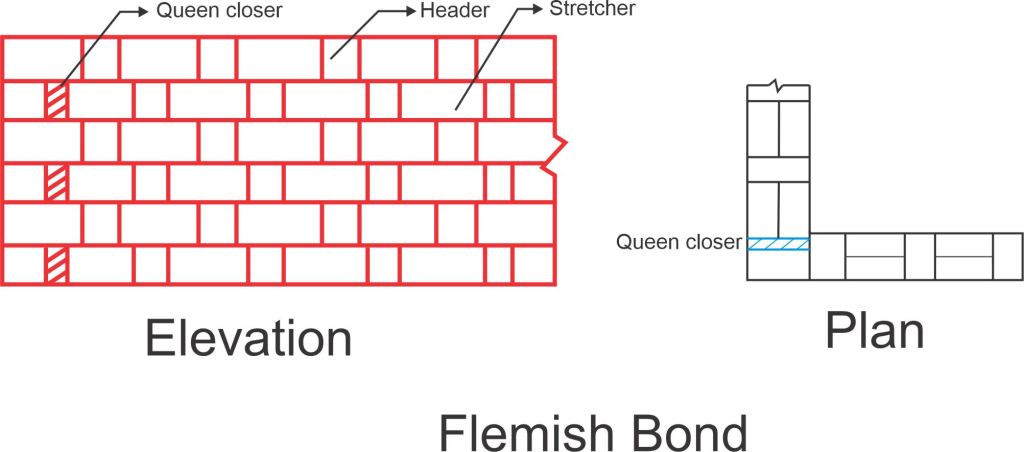
[4] Flemish bond :
Header evenly distributed gives more aesthetic look.
In every course, headers and stretcher are placed alternatively.
Queen closer is put next to quoin header in alternate course to develop face lap.
Double Flemish : alternate course in both front back elevation.
Contain more number of stretcher, so less strong than English bond for wall thickness > one and a half brick.
Use of bats possible, more mortar required.
Require greater skills and craftsmanship.
[5] Dutch bond
Modified form of English bond with quoin of stretcher being three quarter bat.
[6] American bond / Common bond :
English bond with header course at every 5th , 6th, and 7th courses of stretcher.
Header bond act as tie brick between backing and fronting.
Queen closer are inserted at both end of header courses.
Used as exterior load bearing walls.
[7] Stack bond :
Bricks are stacked over each. All bonds are aligned.
Used mostly for decorative purpose and not for load bearing structure.
Quoin
Exterior angle or edge of wall when wall take turn.
Alternate quoin header and stretcher is preferred.
Quoins are made mostly by finished stones.
Square Quoin : when turn makes angle other than 90°. Headers on one face is converted to stretcher on other face.
Expansion Joint :
Reduce crack, absorb movement.
Necessary when length > 15 m
Sealant : rubber, bitumen, coconut pith , expanded plastic etc.
Bricks
Classification :
- First Class : Thoroughly burnt, red , absorption ( 12-15) %, Crushing Strength is greater or equal to 10 N/mm2 /100 Kg/cm2
- Second Class : Small crack, absorption ( 10-20) %, Crushing Strength is greater or equal to 7 N/mm2
- Third Class : Under burnt, absorption = 25 %, temporary structure
- Fourth Class : Overburnt, distorted, brittle, used as ballast
For High class brick masonry , modular bricks are used.
Strength : IS 1077 ; Class 35 – strength is greater than 35 N/mm2
Good brick :
- Uniform size, shape, deep red, cherry colour
- Uniform texture, no impression on scratch
- Metallic sound when struck together.
- Water absorption < 20 % (24 hrs.)
- Crushing Strength > 10 N/mm2
Ingredients :
- Silica : 50 – 60 %
- Alumina : 20 – 30 %
- Lime : 10 %
- Magnesia : <1%
- Ferric Oxide : < 7%
- Alkalis < 10 %
- CO2 , SO3 , H2O : Small %
Silica :
- Retain shape
- Impart durability
- Prevent Shrinkage and warping
- Excess silica makes brick brittle
Alumina :
- Absorb water and render clay plastic.
- If excess, produce crack on burning
- Make concrete refractory.
Lime :
- It reduce shrinkage
- It cause silica melt on burning
- In Carbonated form, lower the fusion point.
- Excess lime can cause melting.
Magnesia :
- Make brick yellow
- It cause clay to soften at lower rate.
Iron :
- Gives red colour on burning with O2
- Improves impermeability and durability.
- It lower fusion point of Clay
- It gives strength and hardness
[Harmful Substances]
Lime :
- In excess, it changes the colour of concrete from red to yellow.
- It swells and disintegrate bricks.
- Should be in fine divided state without lumps.
- It cause blemishes and cracking.
Iron Pyrites :
It oxidises and decomposes brick on burning.
Alkalis :
In excess, melt clay on burning.
It crystallizes in moisture and after drying, it deposits as white powder, called efflorescence.
Organic matter :
It gets charred and leaves pores on burning.
Carbonaceous material :
It produces black core.
Sulphur :
It cause formation of spongy swollen structure in bricks.
Manufacturing of Bricks
This section deals with entire processes and technologies that helps in constructing and shaping the bricks. It also gives us idea about types of bricks based on manufacturing ingredients.
Manufacturing of bricks :
Vitrification : To convert masses into glassy substance at temperature ( 900-1100) °C.
It is done in kilns or clamp. Kiln can be continuous or intermittent.
Kiln : Hoffman kiln (continuous) ; Bull Trench kiln (Intermittent)
Testing of bricks :
- Dimention Test (IS 1077) : 20 pieces are laid flat and cumulative dimensions are taken. Lots with bricks over prescribed limit of tolerance are rejected.
- Water Absorption Test (IS 349-5) : suction rate
- Compressive strength test (IS 3495) : 6 bricks are taken. A sample of two bed faces of bricks are immersed in water at room temperature for 24 hours. Specimen is placed at compressive testing machine.
- Warpage Test (IS 3495 V) : by help of flat steel or glass surface with 10 bricks sample.
- Efflorescence Test (IS 3495 III) : Ends of bricks are kept in 150 mm diameter porcelain or glass dish. For heavy efflorescence, we see deposits in more than 50 % of exposed area. For Serious condition, powder flake away from the brick surface.
- Soundness Test : bricks are struck to produce metallic sound.
Defects in bricks :
- Over burning : viscous or complete Vitrification
- Under burning : no pores closing
- Bloating : excess carbonaceous matter cause spongy swollen mass over brick.
- Black core : bituminous matter not removed by oxidation.
- Efflorescence : alkalis attack, grey white powder
- Chuffs : rain water falling on hot brick cause deformation
- Checks or Cracks : lumps of lime, water
- Spots : Iron sulphide cause dark spot.
- Blister : due to air imprisoned during moulding
- Lamination : thin lamina due to entrapped air in void
- Sulphur attack : sulphate salts reacts with alumina of mortar, cause increase in volume, chipping and spalling.
Bricks should be immersed in water for at least 2 hours, before using for Masonry (to prevent soaking from mortar).
Brick resist fire better than stone.
Types of Bricks :
Refractory bricks:
- Fire clay bricks
- Resist high temperature, chemical and dampness
- Colour : whitish, yellow or light brown
- Minimum compressive strength = 3.5 N/mm2
- Lining blast furnace over kiln
Acid Refractory brick :
- 95-97 % silica, 1.2 % lime , sand stone (Fire Clay)
- For Steel industry
Basic Refractory brick :
- Magnesia (85 %), Calcium Oxide (25 %) and Silica (< 5.5 %)
- Corrosion resistant
- Copper metallurgy
Neutral brick :
- Chromite brick ( 50 % chromite)
- 30 % Iron Oxide
- Bauxide 15 %
- 5 % Silica
- Used for lining copper reverberatory furnace
Autoclave bricks :
- Less water absorption
- Noise reduction
- Less bulk volume of mortar required
- Ornamental work
Heavy Duty brick (IS 2180) :
- Compressive strength is greater than or equal to 440 Kg/cm2 or 40 N/m2
- Water absorption < 10 % (24 hrs)
- Withstand high temperature
- Used for Industrial foundation
Perforated bricks (IS : 2222)
- Cylindrical holes
- Expensive
- Light weight
- Heat insulating properties
- Building walls and partitions
- Compressive strength > 7 N/mm2
- Water absorption < 15 %
Carbon brick :
Crushed coke bonded with tar.
Timbers
In this section we will study about classification of trees, structure and seasoning of timber along with defects that occurs in timbers succeeded by notes on their treatment.

Timber
Classification of Trees
Endogenous :
Tree that grow endwards.
Examples : Palm, Bamboo
Exogenous :
Tree that grow outwards.
Types :
- Conifers : Evergreen trees having pointed needle like leaves.
- Deciduous : have flat board leaves.
| Conifers | Deciduous |
|---|---|
| They show distinct annual rings. | Rings are indistinct |
| Yield Soft wood | Yield hard wood |
| Resinous | non resinous |
| light weight | heavy weight |
| light colour | dark colour |
| Strong along grains | strong along or across the grains |
| Chir, Fir, Deodar | Teak, Sal, Sheesham |
Classification of Timber : IS 399
Modulus of Elasticity : 5.6 – 12.5 KN/ mm2
Structure of Timber :
Bark protect wood from mechanical damage.
Cambium grow wood cells on inside and smaller bast cells on outside. (between inner bark and sap wood)
Heartwood gives strong and firm support to tree. (Shear strength depends on it )
Pith is small area occupied by friable tissue. In felled trees, it easily crumble and rots.
In Cross section, nutrient passes from bast to heart through group cells running at right angle to cambium layer, called Medullary rays.

Seasoning of Timber ( IS : 1141 – 1958)
Seasoning is process of reducing moisture content of timber to approximately equal to average humidity of surrounding to prevent timber from possible fermentation.
Rapid seasoning cause hardening.
Seasoning reduce shrinkage, tendency to split, weight increase strength, durability, workability, and reduce resilience.
Method of Seasoning :
- Natural Air seasoning : reduce water content to 12-15 %
- Boiling : steam spray, quick and expensive
- Water seasoning : sap, sugar and gum are leached out but strength and elasticity reduce.
- Kiln seasoning : large scale, little loss of strength.
- Chemical or Salt seasoning : aqueous solution of chemical have lower vapour pressure. Common salt and urea used.
- Electric seasoning : two ends of logs touch electrodes, generate heat by current cause drying.
- Mc Neil’s Process : best method; Timber is stacked in chambers with air space and combustion products; takes 15-60 days.
Defects in Timber :
Defects due to abnormal growth :
Checks :
- longitudinal cracks normal to annual rings.
- affect durability of timber, admit moisture.
Shakes :
- longitudinal separation between annual rings
- reduce shear strength
- heart shake : due to shrinkage, crack run from pith to sap wood.
- cup shake : curved split, due to frost action on sap wood.
- star shake : radial split, wide at circumference, due to severe frost and heat.
Rindgall :
- swelling caused by growth of layers of sap wood over wound after branch are cut.
- newly developed layers does not unite properly with old rot, leaving cavities, where decay begins.
Knots :
- bases of twigs or branches buried by cambial action of mother branch.
- interrupts basic grain direction of wood, reducing strength.
- reduce workability and cleavability
- types : round, spike, single, cluster and branch
End splits :
- caused by greater evaporation of sap at end grain.
- reduced by painting
Twisted Fibers :
By wind turning the truck.
Upsets :
By crushing of fibers transversely due to winds and felling.
Foxiness :
Yellow or Red tinge or discolouration
Rupture :
Due to injury or impact.
Excrescences :
During growth
Due to Conversion into Timber
Due to Seasoning :
- Checks
- Splitting
- Warpage : uncontrolled loss of moisture
Diseases of Timber
Dry Rot :
Fungus reduce fibers to fine powder in moist and warm confined atmosphere.
Remedy : cut off the affected part
Grey Rot :
Destruction of cellulose of wood due to fungal attack.
Wet Rot :
When timber is subjected to alternate wet and dry cycle, decomposition of tissue take place.
Seasoned timber should be used with preservation and paint
Brown Rot :
Fungal attack in coniferous tree.
Preservation :
- Oil preservative (Type I) : Outside of Timber, Creosote, Carbolinium Tar oil type
- Organic solvent preservative : Toxic chemical compound Pentachlorophenol, benzenehexachloride, DDT, Tar oil type
- Acetic Anhydride treatment, Zinc Chloride, boric acid
- Copper chromate arsenic composition : AsCu treatment
As2O5.2H2O : 1 Part
CuSO4.5H2O : 3 Parts
(NaOrK)2Cr2CO7 : 4 Parts
They do not increase strength and remove moisture.
Treatment Process :
- Hot and Cold process
- Boucheric Process
- Fuel Cell or Bethel Process : pressure process
- Empty Cell process : Lawry process and Rueping process
- Diffusion Process
- Fire Treatment : phosphate of ammonia, borax, Ammonium sulphate ; Abel’s process
Testing of Timber :
- Specific Gravity test : sample ( 50mm x 50 mm) 150 mm length
- Volumetric Shrinkage test : test at temperature (103 degree centigrade)
- Static bending strength test : One point loading, Two point loading and Impact bending strength test
- Compressive strength test
- Tensile strength test
- Cleavage strength test
- Brittleness test : Izod impact test and Charpy impact test
- Age of timber : by counting number of annual rings
Properties of wood :
- Specific gravity of wood = 1.54
- Heat conductivity = 0.15 – 0.27 K
- Sound conductivity
- Ductile material
- Non Isotropic (Anisotropic)
- Modulus of rigidity is low
- Compressive strength perpendicular to fiber is much lower than that of parallel to fiber of wood.
- Compressive Strength = (30-77) N/mm2
- Tensile Strength = (80-90) N/mm2
- Shear Strength = (6.5-14.5) N/mm2
- Mechanical properties of wood are not materially affected by a reduction of moisture content until the point of fiber saturation is reached. (Fiber saturation point is reached when free water is removed, and strength gain and shrinkage is rapid).
- Timber with twisted fiber is used as poles.
- Ratio of elastic modulus of timber in longitudinal to transverse direction = 1 to 2
- Moisture content of timber used as building frame = (8 – 12)%
- Odd number of plies are used for making plywood.