
Harbour is the location that is engineered to provide facilities for ships for berthing, resting as well as loading and unloading of cargoes and passengers.
Basic Concepts related to Harbours
This section provides all concepts and formulas related to Harbour Engineering. We will also cover some basic terms related to Harbours.

Harbour Types :
- Natural : Bombay and Kandla
- Semi Natural : Vishakhapatnam (Protecting only at entrance)
- Artificial : Madras
Site Selection for Harbour :
- Availability for cheap land and construction material.
- Transport and communication facilities.
- Natural protection from winds and waves.
- Industrial location
- Favorable marine conditions
Roadstead :
A hold condition consisting of Harbour walls protecting it from fury of storm.
\large\textcolor{blue}{Harbour \:depth : D = D_1+ \frac{H}{3} + D_2}D1 : draft of largest ship to be accommodated (m)
D2 : allowance for squat of moving ship (m)
H : height of storm waves. (m)
Port – Harbour where terminal facilities like stores, landing of passengers , cargo etc. are added.
Types : Canal ports, River ports, Sea ports
Free port : without payment of duties and intervention of custom.
India has 8 major port, 21 intermediate ports and 144 minor ports.
Littoral Drift :
Carrying away and deposition of material due to current. Harbour is constructed on path of littoral drift faced erosion of sand.
If a harbour is constructed in the path of the littoral drift, there will be accumulation of sand on one side and erosion on the other side of the harbour. Thus, the direction of littoral drift will be governed by the wave direction and the quantity of material moving.
Tide :
Apparent variation of mean sea level due to gravity of sun and moon.
Types of Tides
- Spring Tide : At new and full moon. Tide rise more and fall lesser than other time exceptionally high.
- Neap Tide : At one or two days after moon is in her quarter. Tide rise and fall lower than other time.
- Diurnal : Occur once in a day.
- Semi- Diurnal : Occur twice a day.
Height of spring tide = (1.5-2) times neap tide rise/fall
Tidal plant are built only if the height of tide ≥ 5m
Mean Sea Level
Mean sea level at a place is the average value in all states of the oscillation or in one cycle. It also represents the surface of sea in absence of the tides.
Low Water
It refers to the lowest level of water on one oscillation or in one cycle.
High Water
Highest level reached by the water surface in one oscillation or in one cycle. Highest high water refers to highest spring tide on record.
Uses of Tides:
- It enables efficient loading and unloading operations by providing necessary water depth for a cargo ship to remain afloat.
- It can be predicted in advance.
- Does not cause environmental pollution.
- It involves no fuel.
- It is a perennial source.
Height and Length of the Harbour waves:
Thomas Stevenson formula:
Height of the wave (m)
\large\textcolor{blue}{H = 0.34\sqrt{F} }F = Fetch in km
In Deep water (depth of water > length of water wave)
\large\textcolor{blue}{Velocity(V) = 1.25\sqrt{l}}l = length of wave(m)
In Shallow water
\large\textcolor{blue}{V=3.16\sqrt{d}}d = depth of water (m)
Pressure on unit surface
\large\textcolor{blue}{P= w\:\frac{v^2}{g}}w = weight of unit volume of water.
Minimum turning radius for passenger ship = 2 X ship length.
Harbour Breakwater :
Protective barrier constructed to enclose harbour from effect of heavy seas.
A good alignment is to have straight converging arms so that angle of intersection does not exceed 60˚ .
Avoid straight parallel and diverging arms.
Classification :
- Heap or mounted
- Mound with superstructure
- Upright wall
Protection of Breakwaters
Dumping heavy blocks of concrete on top and on front face resists flattening action of the waves. Granite paving blocks set in cement mortar reduce the erosive action of waves.
Tetrapods
The Tetrapod is a four pronged pre cast concrete block, with prongs radiating at 120 degrees to each other from a common centre.
Each prong is cylindrical in shape and slightly truncated. It provides good interlocking and a good percentage of surface voids for unobstructed flow of the return wave or suction wave.
The centre of gravity of a tetrapod is slightly low, resisting overturning. The wave is broken into smaller streams which collide with each other in the tetrapod gaps and loose their destructive energy.
Mound construction :
- Barge method
- Staging method
- Low level method
Barge Method
We use special barges with flat bottom and hoppers with vertical sides and doors at bottom opening outwards. The hopper uniformly place rubbles at particular locations.
Staging Method
We drive a series of piles at regular intervals of 4500 mm to 6000 mm and connect them with longitudinal runners, struts and braces forming a number of parallel tracks for tipping wagons to move on rails.
Low Level Method
This consists in forming a length of mound from the shore, well above the high sea level and using this for laying tracks and running tipping wagons.

Harbour Docks :
Enclosed area for berthing ships to keep them afloat at a uniform level, to facilitate loading and unloading of cargo.
Wet Docks :
Used for loading and unloading of passengers and cargoes. We should form shapes by straight lines only.
Dry Docks :
For repair of docks. Admit a vessel into chamber, close door and pump out water.
Approach basin provides entrance and provision of locks to control water level.
Keel and Blige block :
Hardwood blocks spaced along centerline of dry dock floor to affront bearing of ship’s keel.
Slipways :
Consist of inclined path of timber or stone upon which a series of rails are present and they run from sufficient depth of water to required height above water level.
Entrance Docks :
Consist of a chamber enclosed by quay walls on each side and paved at bottom by an inverted arch flooring.
Locks have two parts of gates with a lock chamber in between.
Wharves
Platforms or landing places necessary for ship to come close enough to shores. They give sufficient depth of water. They are open structures of piles or posts with bracing.
Quay Walls :
They are wharves along and parallel to shores. Their protection walls are called quay walls. It is designed similar to retaining walls for shore water depth between 10 to 12 meters.
Piers :
They are wharves that project into basin at right angles or oblique angle from shores. Pier head is at top of breakwater near harbour entrance. They demarcate approach channels and are provided with lights.
Jetty
Piled projection from shore to berth vessel alongside.
Resist berthing impact of vessel.
Prevent scouring by diverting current away.
May have berth on two face.
Fender
Cushion material on jetty face for smooth impact.
Material : timber piles, coiled ripe, spring, rubber, buffer etc.
Trestles
Light pier designed to withstand vertical loads, but not docking and mooring forces.
Dolphins
Cluster of closely spaced piles. Piers are pulled together at top and tied by cable.
They are marine structures for mooring vessel, often in combination of wharves and piles.
Used for tying up ships and for transferring cargo from one ship to another.
Types of Harbour dolphins :
- Breasting (have bollard to take lines of ship)
- Mooring (additional one to hold ship)
- Flexible (piles cluster tied by galvanised cable)
- Rigid (piles bolted to wooden cross members)
Impact depends upon mooring speed and angle of ship.
Maximum Impact : when ship fully loaded strike face of deck at an angle of 10˚ .
Slip
Space of water between two adjacent pier, sufficient for two ships to be berthed.
Width ≥ (0-4) X beam of largest ship.
Moles
Structure formed by rock filling and extended from shores. Top of moles provides provision for roads, railways etc.
Apron
Open space left in front of berth, required for loading and unloading. we utilise it for installation of railway track.
Harbour Transit Sheds
One or two storey high buildings for storage of cargoes. They are adjacent to quays and portable cranes are available here.
Harbour Warehouse
Permanent structure on shore for longer duration storage.
Harbour Dredging
Excavation under water to increase depth of waterway.
Capital dredging : rock to silt
Maintenance dredging : Sand to silt
Dredging devices : Dipper dredger, grapple dredger, continuous bucket elevator or ladder and hydraulic or suction dredger.
Navigation in Harbours
In this section we will see how we provide facilities for navigation and lighting at Harbours for easy operations.
Navigational Aids at Harbour
Fixed and floating light stations
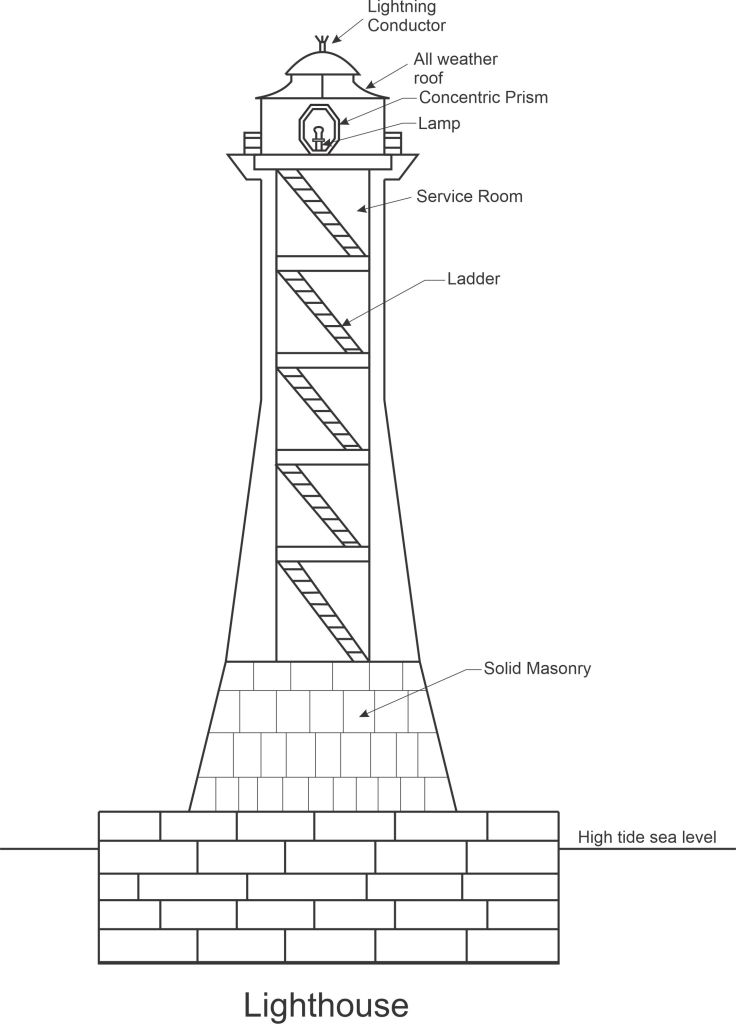
Light House :
Lofty tower divided into no. of floors. Topmost floor contain powerful lighting equipment.
Geographical distance at which lighthouse is first visible.
\large\textcolor{blue}{L = 3.86 (\sqrt{h} +\sqrt{h1})}L (km) , h – height of light house (m)
h1 : height of observer on ship (m) above mean sea level.
Lights : fixed , flashing and occulting
Signal : light signal, fog signal and audible signal.
Light Signals at Harbour
- Light ships : lantern on big ships on steel towers.
- Beacons : any object easily identifiable capable of indicating and guiding in navigation. Eg. hill, chimney, tapering framework etc.
- Buoys : floating structures of small size employed for demarcation of entrance, approach and boundaries etc.
Moored to sinkers or heavy anchors with chains.
Material : steel or iron plates
Maximum distance between two consecutive buoys is 1600m
Diameter: (1.8-3) m
Types : mooring buoy (fixed in position and ships are moored without anchors) and wreck buoys ( to locate wrecks in harbour exterior. Also used for sea cable crossing location).
Harbour Fog Signal
Ordinary or mechanism bells whistles or sirens.
Harbour Audible Signal
Emergency
Explosive signal, siren and oscillators
Mooring
Devices provided where anchorage water is limited.
Type : fixed or floating
Fixed type:
- Mooring port : attached to corners of piers or wharf end.
- Bollard : fastened on concrete docks by bolts. ports designed to take up pulls.
- Capstan : apparatus consisting of an upright cylinder around which the cables are wound.
Floating type : Buoys, Cables and Anchors
Anchors : heavy object which are lowered to bottom by cable or chain to keep vessel from drifting.